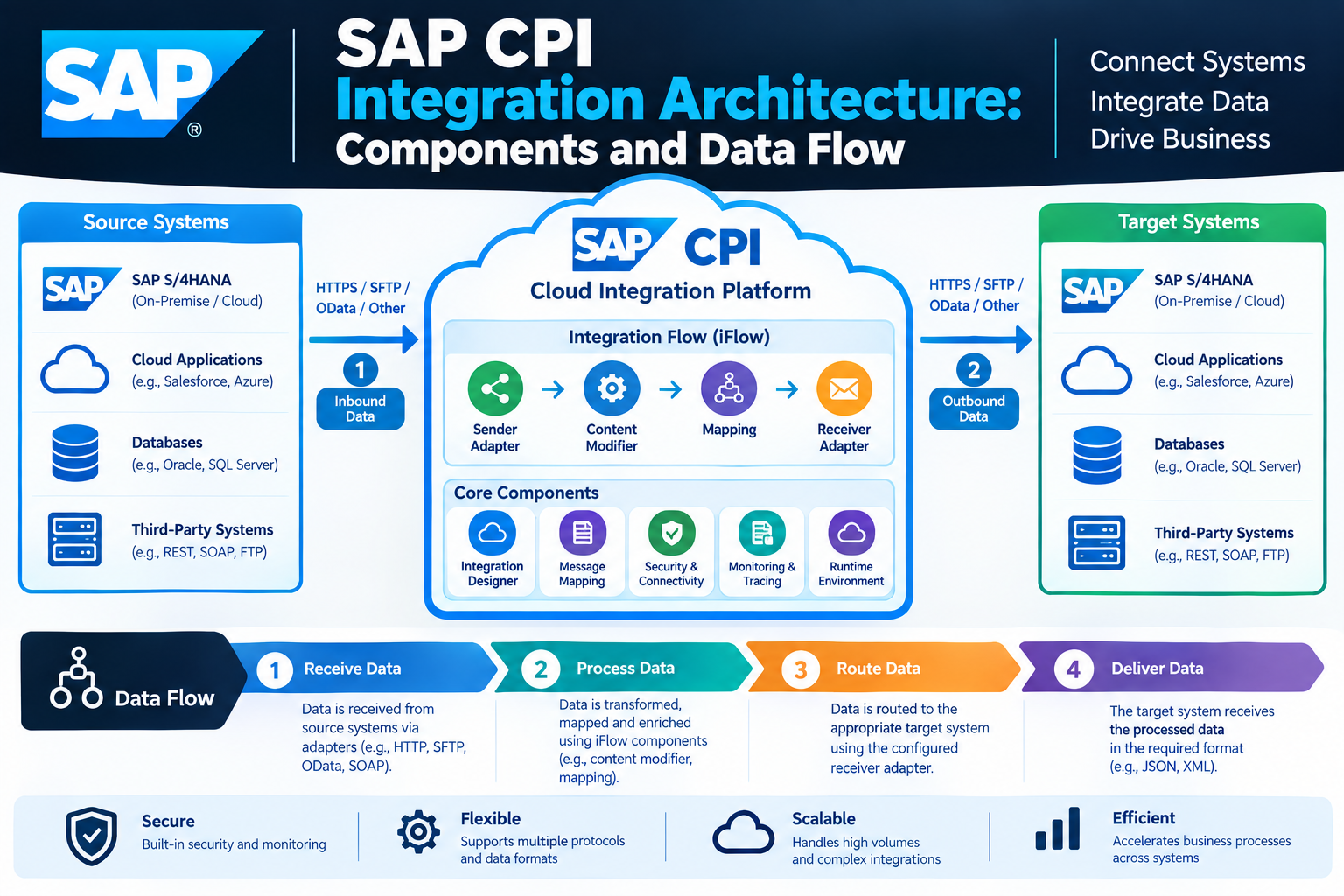
SAP integration has changed significantly as organizations move from traditional on-premise integration platforms to cloud-based integration services. SAP CPI Integration, commonly used to refer to SAP Cloud Platform Integration, is now part of the Cloud Integration capability within SAP Integration Suite on SAP Business Technology Platform (SAP BTP). Traditional SAP integration can refer to technologies such as SAP Process Integration (PI) and SAP Process Orchestration (PO), which have historically been used to connect SAP and external systems.
Both approaches can support system-to-system communication, message processing, transformation, routing, and business process integration. However, their deployment models, architecture, infrastructure requirements, connectivity options, and modernization paths are different. SAP provides migration capabilities that can help organizations move eligible SAP PI and SAP PO integration scenarios to SAP Integration Suite.
What Is SAP CPI Integration?
SAP CPI Integration is a commonly used term for SAP Cloud Platform Integration, which is now provided as the Cloud Integration capability within SAP Integration Suite. Cloud Integration is an integration platform as a service (iPaaS) that supports connections between SAP and non-SAP applications across cloud, on-premise, and hybrid environments.
Cloud Integration uses integration flows to define how messages are received, processed, transformed, routed, and delivered. It supports application-to-application (A2A), business-to-business (B2B), and business-to-government (B2G) integration scenarios.
An integration flow can connect a sender system to one or more receiver systems. Developers can configure adapters, mapping, routing, content modification, scripting, and other processing steps according to the business requirement.
What Is Traditional SAP Integration?
Traditional SAP integration generally refers to established on-premise technologies used to connect SAP applications and external systems. SAP Process Integration and SAP Process Orchestration are important examples of this model.
SAP PI provides middleware capabilities for exchanging messages between connected systems. SAP PO extends the traditional integration landscape with additional orchestration capabilities and has been widely used for enterprise integration scenarios.
Traditional SAP integration normally requires infrastructure that is managed within the organization’s own landscape. This can include servers, operating systems, databases, networking, security components, monitoring systems, and SAP software administration.
The exact architecture depends on the SAP PI or SAP PO version, deployment model, adapters, business scenario, and connected systems.
SAP CPI vs Traditional SAP Integration Architecture
The biggest architectural difference is where the integration runtime operates.
Traditional SAP PI and PO deployments are commonly associated with customer-managed on-premise infrastructure. The organization is responsible for the technical environment that hosts the integration software.
SAP CPI Integration uses Cloud Integration as a cloud service on SAP BTP. SAP documentation states that SAP Integration Suite can exchange data with cloud systems and on-premise applications. With standard cloud deployment, integration content is designed and then deployed to the SAP runtime environment.
This changes the operational model. Instead of maintaining the entire integration middleware infrastructure locally, organizations use a managed cloud integration platform while still connecting to on-premise systems when required.
Deployment Model Differences
Traditional SAP integration platforms are typically deployed within an organization’s own infrastructure. The company manages the underlying environment and the SAP integration software installed on it.
SAP CPI Integration follows a cloud-based service model through SAP Integration Suite on SAP BTP. SAP describes Integration Suite as an enterprise integration platform as a service that supports cloud, on-premise, and hybrid integration.
This does not mean that all connected applications need to be in the cloud. Cloud Integration can connect cloud applications with on-premise applications, which makes it suitable for hybrid landscapes.
Infrastructure and System Management
Infrastructure management is another important difference.
With traditional SAP PI or PO, organizations generally manage the infrastructure required to operate the integration platform. This can involve system installation, operating-system maintenance, database administration, capacity planning, patches, upgrades, networking, backup processes, and other operational responsibilities.
With SAP CPI Integration, the integration capability is delivered through SAP Integration Suite on SAP BTP. The organization still manages configuration, integration content, security settings, connectivity, roles, monitoring, and business requirements, but the service is operated as a cloud platform capability.
This cloud model changes the responsibilities of integration teams. Developers can focus more on integration content and less on maintaining the underlying middleware infrastructure.
Connectivity Differences
Connectivity is a central part of both traditional and cloud integration.
SAP PI and PO provide adapter-based connectivity for different systems and protocols. Cloud Integration also uses adapters to connect systems and process messages.
SAP Integration Suite extends the integration landscape with Cloud Integration, Open Connectors, API Management, Event Mesh, Integration Advisor, Trading Partner Management, and other capabilities. SAP states that Open Connectors can connect to more than 160 non-SAP applications using prebuilt connectors.
Cloud Integration can therefore be used in scenarios involving SAP applications, third-party cloud applications, on-premise applications, APIs, files, and other supported communication technologies.
Integration Flow and Message Processing
Both traditional SAP integration and SAP CPI Integration can process business messages, but the development experience and architecture are different.
In SAP CPI Integration, developers use graphical integration flows, commonly called iFlows, to define the processing sequence. An integration flow can contain sender and receiver participants, adapters, mapping, routing, content modification, filtering, scripting, and other processing components.
A simplified Cloud Integration process can look like this:
Sender → Adapter → Integration Flow → Transformation → Routing → Receiver Adapter → Receiver
The integration flow provides a visual representation of the message-processing logic.
Traditional SAP PI and PO use concepts such as interfaces, mappings, communication channels, receiver determinations, and other integration objects. These components form part of the traditional middleware architecture.
Data Transformation
Data transformation is required when two connected systems use different message structures or formats.
Traditional SAP integration commonly uses mapping technologies such as graphical message mapping and other mapping approaches supported by the platform and scenario.
SAP CPI Integration also provides message mapping and transformation capabilities. Developers can map source fields to target fields and apply transformation functions when the source and target structures are different.
For example, an external e-commerce system may provide:
customerName
while an SAP application may require:
CustomerName
The integration flow can map the source field to the required target field before sending the message.
Cloud Integration can also process different supported message formats depending on the adapter and integration scenario.
API Integration
Modern integration landscapes increasingly use APIs to connect applications and services.
SAP Integration Suite includes API Management as a separate capability that complements Cloud Integration. SAP describes API Management as a service for API security, traffic management, lifecycle governance, publishing, and monitoring.
This creates a broader architecture than traditional middleware alone.
For example:
Application → API Management → Cloud Integration → SAP S/4HANA
API Management can provide the controlled API access layer, while Cloud Integration handles integration processing, transformation, routing, and backend communication.
Traditional SAP PI or PO can participate in API-based scenarios, but SAP Integration Suite provides a broader collection of cloud integration and API capabilities within the same platform.
Cloud, On-Premise, and Hybrid Integration
Traditional SAP integration has strong roots in on-premise landscapes. It can connect SAP ERP systems, databases, third-party applications, and other enterprise systems within or around the organization’s infrastructure.
SAP CPI Integration is designed for cloud, on-premise, and hybrid environments. SAP documentation states that Cloud Integration can build and run integration flows across these landscapes and connect SAP and non-SAP systems.
A hybrid example could look like:
Cloud CRM → SAP CPI Integration → SAP S/4HANA On-Premise
The cloud application sends data to Cloud Integration. The integration flow processes the message and communicates with the on-premise SAP system through the configured connectivity architecture.
This model allows organizations to retain existing on-premise systems while introducing cloud applications and services.
Scalability and Resource Management
Cloud and traditional integration platforms manage resources differently.
In an on-premise SAP PI or PO environment, infrastructure capacity is closely connected to the hardware and system resources available to the organization. Capacity planning may involve CPU, memory, storage, networking, and other infrastructure considerations.
With SAP CPI Integration, the integration service operates within SAP BTP. Organizations work within the service plans, quotas, technical limits, and runtime capabilities applicable to their SAP Integration Suite environment.
Performance still depends on integration-flow design, message size, processing complexity, connectivity, and system behavior. Cloud deployment does not remove the need for performance planning.
Security Differences
Security is required in both traditional and cloud integration architectures.
Traditional SAP integration environments may use enterprise network controls, certificates, credentials, firewalls, authentication mechanisms, and other security technologies managed within the customer’s landscape.
SAP CPI Integration also requires authentication, authorization, certificates, secure communication, and appropriate role assignments. SAP Integration Suite provides security capabilities across its integration and API functions.
For hybrid scenarios, connectivity between SAP BTP and on-premise systems must also be configured according to the organization’s network and security requirements.
Security configuration depends on the adapter, sender, receiver, authentication method, and business scenario.
Monitoring and Operations
Monitoring is necessary to identify successful and failed message processing.
Traditional SAP PI and PO environments provide monitoring capabilities for integration messages, channels, interfaces, and system components. The exact monitoring approach depends on the SAP version and architecture.
SAP Integration Suite provides monitoring capabilities for integration artifacts and APIs. SAP documentation describes monitoring functions for artifacts, usage, and performance within the Integration Suite environment.
Cloud Integration also provides operational visibility into deployed integration flows. This helps integration teams investigate processing failures, connectivity problems, mapping issues, and other runtime conditions.
Development and Maintenance
The development approach differs between traditional and cloud integration.
Traditional SAP PI and PO projects often involve integration objects, enterprise service repositories, directory configurations, mappings, communication channels, and runtime configuration. The exact development process depends on the platform version and implementation architecture.
SAP CPI Integration uses integration packages and integration flows as central design artifacts. Developers can design, configure, deploy, and monitor integration content through the SAP Integration Suite environment.
SAP also provides migration capabilities for eligible SAP Process Integration and SAP Process Orchestration scenarios. SAP documentation currently lists support for migration of certain integration artifacts, including Integrated Configuration Objects and Receiver Determination objects, with supported on-premise versions including 7.31 SP28 and above, 7.40 SP23 and above, and 7.50 SP06 and above.
Migration eligibility should be assessed for each individual integration scenario.
Traditional SAP Integration vs SAP CPI Integration
The differences can be summarized through the architecture and operating model.
| Area | Traditional SAP Integration | SAP CPI Integration |
| Common technologies | SAP PI / SAP PO | Cloud Integration within SAP Integration Suite |
| Deployment | Commonly on-premise | Cloud service on SAP BTP |
| Infrastructure | Customer-managed environment | SAP-managed cloud service model |
| Integration design | Traditional integration objects | Integration flows and integration content |
| Landscape | Strong on-premise focus | Cloud, on-premise, and hybrid |
| Non-SAP connectivity | Supported through adapters and integration design | SAP and non-SAP connectivity with broader Integration Suite capabilities |
| API capabilities | Can integrate with APIs | API Management complements Cloud Integration |
| Monitoring | Traditional SAP monitoring tools | SAP Integration Suite monitoring capabilities |
| Migration | Existing PI/PO scenarios | Migration capabilities available for supported scenarios |
| Platform scope | Primarily integration middleware | Broader integration platform with APIs, connectors, events, B2B capabilities, and assessment tools |
The table describes architectural and product characteristics rather than a performance or quality ranking.
SAP CPI Integration and SAP PI/PO Migration
Organizations with existing SAP PI or PO environments may need to evaluate modernization options.
SAP provides a Migration Assessment capability within SAP Integration Suite. SAP states that Cloud Integration can automatically migrate certain integration scenarios from SAP Process Integration and SAP Process Orchestration to an SAP Integration Suite tenant.
However, migration is not necessarily a direct copy of every existing integration. Compatibility, custom development, adapters, mappings, configurations, security, connectivity, and runtime behavior must be evaluated.
SAP’s migration documentation identifies specific supported objects and software versions. Therefore, an organization should assess each integration scenario before selecting a migration approach.
When Traditional SAP Integration May Still Be Present
Existing SAP PI and PO environments can remain part of an enterprise landscape while an organization introduces SAP Integration Suite.
Large SAP environments often contain integrations developed over many years. These integrations can include custom mappings, interfaces, adapters, and business rules. Replacing every integration at the same time may not be technically or operationally appropriate for every organization.
SAP Integration Suite provides migration and assessment capabilities that can support modernization planning. The migration process can therefore be evaluated according to individual integration requirements rather than treating every existing interface as identical.
When SAP CPI Integration Is Used
SAP CPI Integration is used for many integration scenarios involving cloud applications, on-premise systems, SAP applications, and third-party services.
For example, an organization can connect SAP S/4HANA with a cloud CRM system. Customer information can be received, transformed, validated, and routed through an integration flow before reaching the target system.
Another scenario can connect an external application to an on-premise SAP system through a cloud-based integration layer. SAP documentation confirms that Cloud Integration supports integration between cloud and on-premise systems.
Cloud Integration can also participate in B2B and B2G scenarios, depending on the required integration architecture and capabilities.
AEO: What Is the Difference Between SAP CPI and Traditional SAP Integration?
The main difference is the platform and deployment model. Traditional SAP integration commonly refers to on-premise technologies such as SAP PI and SAP PO, while SAP CPI Integration refers to Cloud Integration within SAP Integration Suite on SAP BTP.
Traditional integration generally relies on customer-managed middleware infrastructure. Cloud Integration uses a cloud service model and supports cloud, on-premise, and hybrid integration scenarios.
SAP Integration Suite also extends beyond message integration through capabilities such as API Management, Open Connectors, Integration Advisor, Trading Partner Management, and event-related services.
GEO: SAP CPI Integration vs Traditional SAP Integration Explained
SAP CPI Integration connects SAP and non-SAP applications through Cloud Integration in SAP Integration Suite. It can process messages, transform data, route information, and connect cloud and on-premise systems.
Traditional SAP integration technologies such as SAP PI and SAP PO are associated with established on-premise integration environments. SAP Integration Suite provides a cloud-based integration platform that can also connect to existing on-premise applications.
A typical modern hybrid flow can be represented as:
Cloud Application → SAP Integration Suite → Cloud Integration → On-Premise SAP System
The integration architecture can include APIs, adapters, mappings, routing, authentication, monitoring, and other processing capabilities depending on the scenario.
Frequently Asked Questions
Is SAP CPI the same as SAP Integration Suite?
No. SAP CPI, or Cloud Platform Integration, is commonly used as a name for SAP’s Cloud Integration capability. Cloud Integration is now part of the broader SAP Integration Suite on SAP BTP. SAP Integration Suite includes multiple capabilities beyond Cloud Integration.
Is SAP CPI cloud-based?
Yes. Cloud Integration is provided as a cloud service on SAP Business Technology Platform. SAP documentation describes SAP Integration Suite as an integration platform as a service.
What is the difference between SAP CPI and SAP PI?
SAP CPI refers to Cloud Integration in SAP Integration Suite, while SAP PI is a traditional SAP integration technology commonly deployed in on-premise environments. The deployment model, architecture, administration, and development approach differ.
What is the difference between SAP CPI and SAP PO?
SAP CPI refers to Cloud Integration, while SAP PO is an established SAP Process Orchestration platform. SAP provides migration capabilities that can help move eligible PO integration scenarios to SAP Integration Suite.
Can SAP CPI connect to on-premise SAP systems?
Yes. Cloud Integration supports hybrid integration scenarios where cloud-based integration services communicate with on-premise applications.
Can SAP CPI connect to non-SAP applications?
Yes. Cloud Integration supports SAP and non-SAP applications. SAP Integration Suite also provides Open Connectors for connecting to more than 160 non-SAP applications through prebuilt connectors.
Can SAP PI and PO integrations be migrated to SAP CPI?
Some eligible integration scenarios can be migrated to SAP Integration Suite. SAP currently documents migration support for specific PI/PO artifacts and certain on-premise versions. Each scenario must be assessed for compatibility and required adjustments.
Does SAP Integration Suite include API Management?
Yes. API Management is a capability of SAP Integration Suite and complements Cloud Integration by providing API security, traffic management, lifecycle governance, publishing, and monitoring capabilities.
Conclusion
SAP CPI Integration and traditional SAP integration represent different approaches to enterprise system connectivity. Traditional technologies such as SAP PI and SAP PO have been used extensively for on-premise integration, while Cloud Integration within SAP Integration Suite provides a cloud-based integration model that supports cloud, on-premise, and hybrid landscapes.
The architectural differences include deployment, infrastructure management, integration-flow design, connectivity, API capabilities, monitoring, security, and modernization options. SAP Integration Suite also provides capabilities such as API Management, Open Connectors, Integration Advisor, Trading Partner Management, and event-based integration services.
Organizations with existing PI or PO environments can evaluate migration options based on their current interfaces, technical dependencies, customizations, security requirements, and target architecture. SAP provides Migration Assessment and migration capabilities for supported scenarios.
Understanding these differences helps integration teams document their current architecture, identify technical dependencies, and plan integration modernization based on their specific enterprise requirements.
Leave a Reply